Many times I find myself focusing on how to help students who are struggling. It's the main reason I decided to flip my 9th grade math class a few years ago. However, I have had an interesting situation develop with my advanced students.
After trying flipped mastery at the beginning of the year and realizing it wasn't working (read Week 3 Reflection: Regrouping) I returned to the flipped format I was using last year. Prior to our winter break we gave students an assessment over the Linear Functions unit. Unfortunately, the results were extremely disappointing. Most students failed, so after break we regrouped, reviewed, and re-assessed. However, I had 13 students (out of about 100) who scored 80% or higher. I just couldn't stomach the thought of making them review and reassess when they clearly understood the concepts. So I gave them a choice; you can review and reassess with the rest of the class OR you can move ahead and work at your own pace. ALL 13 students took me up on the idea!
Luckily I have most everything ready from last year's flipped Algebra 1 class and only need to tweak a few things and stay ahead of the most eager student. I have them sitting in a group together, helping one another and coming to me when they have questions. After they check the practice assignment for each concept against the answer key they must meet with me briefly. From time to time they will pause (of their own free will) and be my "classroom experts" and help other students. I have a few who are very eager and will be ready for the final exam for this trimester in the next week or so. The trimester doesn't end until the beginning of March!
Our typical path for students is Algebra 1 in 9th grade, Geometry in 10th, Algebra 2 in 11th and a senior math class (either Trig, Stats, or Consumers Math). If students were identified in 7th grade as advanced they took Algebra 1 in 8th grade which put them on course to take AP Calculus their senior year. I have spoken with a few of the most advanced students who are progressing rapidly about the possibility of not only finishing the Algebra 1 curriculum this year but getting started on Geometry. This gives them the opportunity to advance through our curriculum and be able to take AP Calculus their senior year (Geometry, Algebra 2, and Trig are only 2 trimesters, Algebra 1 is 3). Thus far the several students I have spoken with about this opportunity are excited for the challenge!
Showing posts with label Flipped Classroom. Show all posts
Showing posts with label Flipped Classroom. Show all posts
Sunday, February 2, 2014

Sunday, September 29, 2013
Week 4 Reflection: Progress
This week I found myself able to breathe and relax a bit. Students are getting comfortable with class and are realizing I expect them to take responsibility for their own understanding. Memorable moment of the week; a student whose struggling completed a practice assignment, upon grading it realized they had many mistakes and asked "can't I just turn it in to have it done?" No Honey, it's not about completion, it's about understanding. We are making progress. Slow, steady progress.
As students come into class I have the tracking spreadsheet up. If you are in the red you're in a row. Being in the red means that students haven't completed their WSQ (watched video, summarized with notes, and answered questions online). In rows they need to grab a netbook and complete their WSQ.
For those in groups we've been starting class with our Rapid Review. Students grab a whiteboard and I put up some problems from the concept covered in huge video. They work them out, show me their answers/work and I can identify who needs help and provide some remediation. I also use students' answers to their online submissions (the "Q" part of WSQ) to guide what we do for Rapid Review.
Next students have flex time and work on their practice. I also use this time to pull together small groups for remediation and help students individually. We end class with a whole class activity. Lately we've been finding mistakes in student work or doing number talks.
We also have a number of interventions from our Freshman Academy including academic detentions, meeting with counselors, parent calls home, and Link Crew lunch study buddies. There are a few students I need to meet with about retaking their first unit test. Progress is happening. Slowly but surely.
Saturday, September 21, 2013
Week 3 Reflection: Regrouping
I feel that as educators it is so important for us to be reflective about what we do and responsive to our students. As a type A perfectionist I sometimes get so caught up in my commitment to an idea that I forget they just don't always work out the way we plan. Although my students were learning the process of flipped mastery there were some unintended consequences that are quite frankly not good for my students. Or for me. As Gary Strickland (@SciAggie) from my PLN tweeted me this week "stepping away from a plan that's not working isn't the same as giving up. Regroup and move forward." So this week...I regroup.
Unintended Consequences
I had my mastery portion set up so that students would take a short five question quiz after learning each concept to show their level of understanding. This week it became evident how that worked to dramatically increase many students' test anxiety. I have always worked diligently to lessen that anxiety so it did not sit well with me that this increased.
I also found that the necessary management of reteaching several groups of students who were on different concepts took up so much of my time that I was having less time with my most struggling students. I always have students who, because of failing middle school math, tend to sit and do nothing due to their severe lack of basic math knowledge. However, when flipping last year I found that I had time to sit and work with them. Not so while implementing mastery.
I also feel that I don't have as good a grasp on what my students really know because I haven't been able to have those quality conversations with individual students. There is just too much chaos. And I'm not a sissy when it comes to organized chaos. I have five kids of my own! Chaos is the norm for me in my life. But what's been going on in my classroom has not been beneficial chaos. For my students or for me. It is okay to acknowledge that. And to make a new plan to fix it.
Right Fit?
Now its true that there may be things I could do differently to manage my time and students better. Maybe there is a solution to make continuing mastery viable. But maybe, just maybe, its not right for me...right now. And maybe, just maybe, its not right for my students...right now.
I work with all freshman in a Freshman Academy setting (I'll blog about that at a later date). We have four core teachers who have the same 125 students all year at the high school level. We have the opportunity to have great conversations about our students. And we are working to help successfully transition them to high school. We are finding that our students are coming from a middle school experience where they rarely had homework. Collectively we have an expectation of about 5 hours of homework per week. That transition is very overwhelming for our students. At some point I have to accept that our collective goal of getting 100% of our freshman to graduation is greater than my personal goal of doing flipped-mastery.
Regrouping
I've decided that rather than quizzing over each concept we will have a quiz for every 2-3 concepts. This means that rather than having maybe eight quizzes in a unit we will have about 2-3. The day following a quiz I will build in reteaching for as many students that need it. If that's the whole class its okay.
I also found that students were trying to skirt the system a bit by taking quizzes without authentically watching the video, summarizing with notes, and answering the questions online. We will be staying together as a group more. When students come into class they will need to show me their notes and have done the online submissions in order to sit in a group with their friends. I have a tracking spreadsheet to show me who has done theirs (thanks Crystal Kirch). Otherwise they will sit in a row with a netbook and get that done.
Meanwhile, those who have their WSQ done (watched video, summarized w/ notes, question submission) will get a "rapid review". Student grab whiteboards, I put up a few questions on the board, and we check their understanding of the concept and clarify any misunderstanding. This helps me identify those who need small group intervention and gives those students who crave the "tradition" style a bit of that. By the time we get to small groups those watching the videos in class should be done and can join the small group if they feel they need the extra help. Those not needing small group can get started on the practice. When small group is done they can then get started on the practice.
Since I'm finding that students (especially freshman) get a little squirrelly near the end of class we will do a whole class activity for the last 10-15 minutes of class (keep in mind I have 71 minute class periods). These will be number talks or problem solving activities (see my post on Whole Class Activities).
Here's a recap of class time:
There's a part of teaching we don't talk about much. It's intuition. It's time for me to listen to it. Are there growing pains in trying something new? Of course. But there's also personal growth in reflecting on the journey and listening to your heart. What's your's saying to you?
Unintended Consequences
I had my mastery portion set up so that students would take a short five question quiz after learning each concept to show their level of understanding. This week it became evident how that worked to dramatically increase many students' test anxiety. I have always worked diligently to lessen that anxiety so it did not sit well with me that this increased.
I also found that the necessary management of reteaching several groups of students who were on different concepts took up so much of my time that I was having less time with my most struggling students. I always have students who, because of failing middle school math, tend to sit and do nothing due to their severe lack of basic math knowledge. However, when flipping last year I found that I had time to sit and work with them. Not so while implementing mastery.
I also feel that I don't have as good a grasp on what my students really know because I haven't been able to have those quality conversations with individual students. There is just too much chaos. And I'm not a sissy when it comes to organized chaos. I have five kids of my own! Chaos is the norm for me in my life. But what's been going on in my classroom has not been beneficial chaos. For my students or for me. It is okay to acknowledge that. And to make a new plan to fix it.
Right Fit?
Now its true that there may be things I could do differently to manage my time and students better. Maybe there is a solution to make continuing mastery viable. But maybe, just maybe, its not right for me...right now. And maybe, just maybe, its not right for my students...right now.
I work with all freshman in a Freshman Academy setting (I'll blog about that at a later date). We have four core teachers who have the same 125 students all year at the high school level. We have the opportunity to have great conversations about our students. And we are working to help successfully transition them to high school. We are finding that our students are coming from a middle school experience where they rarely had homework. Collectively we have an expectation of about 5 hours of homework per week. That transition is very overwhelming for our students. At some point I have to accept that our collective goal of getting 100% of our freshman to graduation is greater than my personal goal of doing flipped-mastery.
Regrouping
I've decided that rather than quizzing over each concept we will have a quiz for every 2-3 concepts. This means that rather than having maybe eight quizzes in a unit we will have about 2-3. The day following a quiz I will build in reteaching for as many students that need it. If that's the whole class its okay.
I also found that students were trying to skirt the system a bit by taking quizzes without authentically watching the video, summarizing with notes, and answering the questions online. We will be staying together as a group more. When students come into class they will need to show me their notes and have done the online submissions in order to sit in a group with their friends. I have a tracking spreadsheet to show me who has done theirs (thanks Crystal Kirch). Otherwise they will sit in a row with a netbook and get that done.
Meanwhile, those who have their WSQ done (watched video, summarized w/ notes, question submission) will get a "rapid review". Student grab whiteboards, I put up a few questions on the board, and we check their understanding of the concept and clarify any misunderstanding. This helps me identify those who need small group intervention and gives those students who crave the "tradition" style a bit of that. By the time we get to small groups those watching the videos in class should be done and can join the small group if they feel they need the extra help. Those not needing small group can get started on the practice. When small group is done they can then get started on the practice.
Since I'm finding that students (especially freshman) get a little squirrelly near the end of class we will do a whole class activity for the last 10-15 minutes of class (keep in mind I have 71 minute class periods). These will be number talks or problem solving activities (see my post on Whole Class Activities).
Here's a recap of class time:
- Rapid Review/Watch Video 10-15 min
- Practice/Small Group Interventions 40-50 min
- Whole Class Activity 10-15 min
There's a part of teaching we don't talk about much. It's intuition. It's time for me to listen to it. Are there growing pains in trying something new? Of course. But there's also personal growth in reflecting on the journey and listening to your heart. What's your's saying to you?
Sunday, September 15, 2013
Week 2 Reflection: Breathe!
Even though my level of exhaustion at the end of the day continues to be high. Overall, it has been a good week filled with student progress and administrative conversations. Here's the highlights!
Positives:
Students are getting the hang of the process and I have several who have finished the first unit ahead of schedule. Everyone has made some progress, some more than others.
I have tweaked my organization for quiz retakes to help me better pull together students who need small group interventions. When I grade that day's quizzes I have half sheets for quiz retakes and fill them out for students who need to retake, noting their original score. I then gather these by concept and work with students in groups. I'm finding that some students can explain concepts when we work in a small group adequately although they may do poorly on a paper & pencil quiz. Therefore, if they show me mastery of the concept in small groups I give them a passing score on the quiz.
Negatives:
I have some students falling behind and really struggling. There are so many that need help that I find it difficult to get to everyone. I also have some who are resisting flipped. I expected this. Students who are used to "playing school" tend to resist flipped because it requires that they take responsibility for their learning. I will be calling home for my struggling students this week.
Positive or Negative?
I'm not sure if this is positive or negative. I have begun to realize that flipped mastery is magnifying the need for differentiation in my students. It would normally take quite some time for those who might be disengaged, not really taking notes, and not being authentic on the practice problems to be identified. But now they are quickly identified. This is good because then it allows me to more quickly get them help. The difficulty is that there are so many. I just can't seem to keep up.
Conversation with Administration
I asked my principal to come in and observe me this week. I just asked him to be an objective pair of eyes and tell me what he sees. It was a very good experience. He noted that when I talked to groups I would inadvertently put my back to the rest of the room. As soon as he mentioned it I remember making the conscious effort NOT to do that last year when I flipped. It was a good reminder. He also noticed that when students would encounter a question they would just stop, put their hand up, and wait for me. This will be something I need to work on. I'm thinking about something like "ask three before me" kind of thing. It will be part of our focus for this week. Most students were on task most of the time. Given that this is the second week of school and these are freshmen says a lot. They have much individual work time and they are using it well, most of the time. I'll take it! He was also impressed with how well they have have learned the procedures of the class. He stopped a few when they were turning in quizzes, etc. and asked what they were doing and what they were supposed to do next. They seem to understand and I'm proud of their efforts.
My assistant principal, who oversees our Freshman Academy, had some wonderful advice for me this week. Breathe! She was right. It was time to breathe and get to know my students. I'll continue to do that this week. When introducing the procedures of the class I struggled with whether or not to take the band-aid off slowly or just rip it off, so to speak. I was a bit too focused on getting that right and because of that I had a less intensive focus on my students themselves. It's good reflection to keep in mind for next year.
So this week I will continue to breathe. To get to know my students. To get them to buy into me and my devotion for them. It was a good week.
Positives:
Students are getting the hang of the process and I have several who have finished the first unit ahead of schedule. Everyone has made some progress, some more than others.
I have tweaked my organization for quiz retakes to help me better pull together students who need small group interventions. When I grade that day's quizzes I have half sheets for quiz retakes and fill them out for students who need to retake, noting their original score. I then gather these by concept and work with students in groups. I'm finding that some students can explain concepts when we work in a small group adequately although they may do poorly on a paper & pencil quiz. Therefore, if they show me mastery of the concept in small groups I give them a passing score on the quiz.
Negatives:
I have some students falling behind and really struggling. There are so many that need help that I find it difficult to get to everyone. I also have some who are resisting flipped. I expected this. Students who are used to "playing school" tend to resist flipped because it requires that they take responsibility for their learning. I will be calling home for my struggling students this week.
Positive or Negative?
I'm not sure if this is positive or negative. I have begun to realize that flipped mastery is magnifying the need for differentiation in my students. It would normally take quite some time for those who might be disengaged, not really taking notes, and not being authentic on the practice problems to be identified. But now they are quickly identified. This is good because then it allows me to more quickly get them help. The difficulty is that there are so many. I just can't seem to keep up.
Conversation with Administration
I asked my principal to come in and observe me this week. I just asked him to be an objective pair of eyes and tell me what he sees. It was a very good experience. He noted that when I talked to groups I would inadvertently put my back to the rest of the room. As soon as he mentioned it I remember making the conscious effort NOT to do that last year when I flipped. It was a good reminder. He also noticed that when students would encounter a question they would just stop, put their hand up, and wait for me. This will be something I need to work on. I'm thinking about something like "ask three before me" kind of thing. It will be part of our focus for this week. Most students were on task most of the time. Given that this is the second week of school and these are freshmen says a lot. They have much individual work time and they are using it well, most of the time. I'll take it! He was also impressed with how well they have have learned the procedures of the class. He stopped a few when they were turning in quizzes, etc. and asked what they were doing and what they were supposed to do next. They seem to understand and I'm proud of their efforts.
My assistant principal, who oversees our Freshman Academy, had some wonderful advice for me this week. Breathe! She was right. It was time to breathe and get to know my students. I'll continue to do that this week. When introducing the procedures of the class I struggled with whether or not to take the band-aid off slowly or just rip it off, so to speak. I was a bit too focused on getting that right and because of that I had a less intensive focus on my students themselves. It's good reflection to keep in mind for next year.
So this week I will continue to breathe. To get to know my students. To get them to buy into me and my devotion for them. It was a good week.
Saturday, September 7, 2013
First Week Reflection: Initiating Flipped Mastery
The first week has come and gone. I'm exhausted! My students are learning the process of flipped mastery learning and I am trying to ride the waves while maintaining my optimism. It is not an easy task.
To better understand my reflection you need to be aware of how I have structured things. Students have a basic work flow;
Watch video
Summarize by taking notes (I give them guided notes to help)
Questions submission (answer questions about the content online)
Practice what they've learned and correct it with answer key, fix mistakes
Check in with me (basically check to see if notes & practice are done authentically)
Quiz over the concept (must retake if score less than 70%)
We have been modeling watching videos and taking notes in class. Many soon realized that they would rather watch the videos in their own learning space so that they can do so at a pace that works for them. This helped to move them to that goal by the end of the week. Starting next week, viewing content will be done in the individual student work space either at home or in class on their personal device or one of my classroom netbooks.
By the end of the week students were having discussions about math and working together to understand. For the most part. I am quickly identifying students who are disengaged, mostly because of a lack of understanding of basic math. This is an Algebra 1 class and we start with a review of fractions. Maybe this isn't the best idea as most students (and adults) struggle with fractions. However, we find that the inability to do fractions limits students ability to do more complex work throughout the year. So we start there.
The check in process is meant to be a way for me to quickly ascertain students' needs. I struggle with it because I find that there is so little of me to go around that I fly through the quick conversation because I'm trying to get to everyone. I'm not sure how to rectify this but I don't want to give up on it quite yet.
I give students choice in the practice assignments. They choose the level of difficulty and have other problems that they must do. Students are still getting the hang of it but they seem to appreciate having options. I have started to teach some students who are severely struggling to focus on the more basic problems to help lessen their frustration and support them in acquiring some progress.
What is frustrating me most is that I have uncovered students cheating on the concept quizzes. I have multiple versions of the daily quiz (which has questions for every concept) and have found students putting answers to a version of the quiz that was used previously. This means they are taking other students quizzes and copying the answers. Unfortunately, I have been so focused on students learning the process of class that I have not been teaching them to work that process with integrity. That will be our discussion and focus for next week.
I think this is evidence if how struggling students have learned to "play school" in a traditional system. Because students have not been held accountable for taking responsibility for their understanding they copied and cheated (or were just passed on due to social promotion) to move through grades. Now I'm asking them to show they understand and they fall back on old habits or try to shut down.
Class time is very chaotic as I try to reach every student. I feel like many are falling through the cracks because I just haven't been able to meet their needs. Yet. It's early. But there is one thing that has become very evident to me. The traditional way is so wrong for kids! I'm not saying the aren't amazing teachers who do great things in a traditional classroom. But as I watch what is happening in my classroom I think about how it would be different for my students if this were a traditional classroom. My go-getters would be sitting there bored out of their minds instead of 3-4 concepts ahead of the others. My strugglers would be watching content fly by them with no level of understanding, broken and disengaged. Instead, even though they are still on the first concept of the first unit, they are right where they need to be. Still learning. Slowly. Ever so slowly.
As I work through the pitfalls and hurdles I feel the fear creeping in. It is a constant battle every day to remain positive and optimistic. To not get angry that students aren't taking advantage of the huge opportunities I'm trying to give them to finally learn a subject that has remained foreign to them for many years. And even though I am surrounded by colleagues and administrators who are supportive I am left feeling lonely and isolated. It's hard trying something new. But my fear has nothing to do with me. I'm not fearful of trying something new and having it not work. If it doesn't I will learn and move on. I'm not afraid to make a mistake. Tomas Edison failed many times before succeeding with his many inventions. I'm not afraid of failing for me. I'm afraid of failing my students.
They are why I do this. Why I work so hard. Why I'm trying something new. Something I know will work if I just figure how. I guess to fall back on my optimism I must remind myself it is a journey. This week was one of many. Maybe it's one of the failures. Maybe there were some successes. Either way it is one small step of a long journey to help kids truly learn. Great things are not accomplished without great sacrifice, hard work, unwavering determination and a good dose of faith.
So I guess, once again, it's time to let go of the fear.
Monday, August 12, 2013
Flipped Mastery: My Blueprint
As the school year draws near it has come time to finalize some decisions and layout my game plan for running my Algebra 1 course as a "flipped mastery" course. Here is that blueprint, which includes the following:
Background
I will have ninth graders all year as part of a new Freshman Academy initiative in our building. The benefit for my flipped-mastery approach is that I won't have to get new students used to the routine and new approach each trimester. Last year I flipped the entire year of Algebra 1. Although I have many videos and guided notes to reuse this year, the first three units will need major revamping. I changed things quite a bit during the first trimester last year as I found what worked (and didn't) for myself and my students. I am also changing our practice assignments quite a bit from last year. They are now tiered with a points systems that allows students to have a choice in the problems they do and the difficulty. It allows for greater differentiation.
I also have the following resources in my classroom:
.jpeg)



- Background
- General Policies
- Assessments
- Class Structure
- Student Work Flow
- Students Who Do Not Finish Curriculum
- Physical Set-Up of Classroom
Background
I will have ninth graders all year as part of a new Freshman Academy initiative in our building. The benefit for my flipped-mastery approach is that I won't have to get new students used to the routine and new approach each trimester. Last year I flipped the entire year of Algebra 1. Although I have many videos and guided notes to reuse this year, the first three units will need major revamping. I changed things quite a bit during the first trimester last year as I found what worked (and didn't) for myself and my students. I am also changing our practice assignments quite a bit from last year. They are now tiered with a points systems that allows students to have a choice in the problems they do and the difficulty. It allows for greater differentiation.
I also have the following resources in my classroom:
- 1 cadet teacher (an upperclassman)
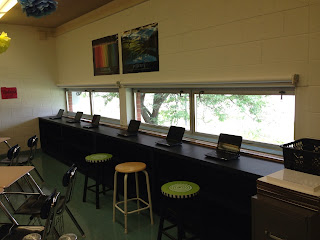
- 15 netbooks in the classroom with Wifi
- 24 mp3 players (for students who don't have internet access at home)
General Policies
- Students can move at their own pace. A “minimum pace” will be established and documented in a class calendar available to parents and students through class website.
- Benchmark of 70% for assessments (quizzes and unit assessments). Students must meet this in order to move to next concept/unit.
- Assignments that are not completed on pace will be marked “missing”. If assignments are not completed by the Unit Assessment date they will become a zero until students complete them. Note: I have decided to do it this way because I feel that my students will need the "incentive" and parents will need the grade to reflect that a student is behind. I know there is debate about putting in zeros for work that is not complete and I am not sure I will always do it this way, but I need to make some decisions for a starting point and this is it.
- Parent contact: Contact home will be made if students fall a few days behind pace. Note: This very well will be done by the student themselves during class.
- Students behind pace: Students will have a 1 week window to complete what is “on pace”. If they become 1 week behind I will call home and require after school tutoring to catch up. If students do not attend after school tutoring they will be required to attend academic lunch detention. Note: We have free after school tutoring with transportation home. The academic lunch detention will be run by our Link Crew (some of whom are also Cadet Teachers).
Assessments
- Concept quizzes and retakes will be done in class in a "testing area". There is a "Today's Quiz" folder that contains multiple class copies of a "unit" quiz; broken down into sections by concept. Students do not write on these. Each concept has 4-5 questions. I have 12 versions of "Today's Quiz" and put out a new version each day. Students use the version for that day for their initial quiz or retake, whichever they are doing that day. Students have a quiz answer tpacket (SEE EXAMPLE) that they write down their work and answers to make grading easier. Note: I got this idea from @crystalkirch. It is how she has found to be the most efficient way to run paper-pencil quizzes and keep your sanity while grading them!
- Unit assessments will be taken in class during the on pace assessment date. Students who are behind will still take the unit assessment. If they do not score 70% or better they will retake it after completing the outstanding material. Note: I have struggled with what to do with this aspect of my flipped-mastery approach. I feel without the pressing assessments students will fall desperately behind. I may be selling them short and will revisit this if it seems necessary to do so. By having students take the assessments (even if not "ready") I can at least better ascertain how they are doing on the material they have learned.
- Unit assessments retakes will be done before or after school according to a set schedule. Students will need to fill out a "Retake Request Form" (I still need to develop this). This will require students to explain what they didn't understand on the prior assessment (with corrections to their mistakes attached), what they did to prepare, what their original score was, and what they anticipate scoring on the retake.
Class Structure
- Whole-class activity (see BLOG POST of these ideas)
- Check-In during which students get into groups, testing area, netbooks, etc.
- Flex-time during which students have their individual or small group work time (see Student Work Flow)
- Check-Out during which students fill out check out slips to help them reflect on and plan their time (SEE EXAMPLE)
Student Work Flow
From the students perspective, here is the work flow:
- Watch video and complete all guided notes & summary questions (via Google Form)
When they submit answers they are given link to responses. They can check their answers against mine and see how I have coded their answers (GREEN=good, YELLOW=almost, RED=wrong). They will record the date of their submission and the color score on the front of their guided notes packet (I call them VIP Packet - SEE EXAMPLE)
- Complete practice assignment: Students grade their own at the "grading station" and record their score on the front of their VIP Packet. They may work individually or in a group.
- Teacher Conference: Students must get their VIP Packet signed off by me under the "Info & Notes" column. We have a brief discussion about their practice problems and I look over their notes.
- Take concept quiz: The student then takes that day's version of the quiz and turns it in. I will return them, graded, the next day. Students keep track of their scores on the front of their Quiz Packet
- Passed - student moves onto next concept
- Did not pass - student reviews mistakes, gets reteaching in small group or individually with me then reassesses.
Students Who Do Not Finish
Although we are on trimester I will have students all year. At the end of the trimester any assignments/assessments that students have not completed will be given a zero and that grade (failing if they have not completed curriculum) will be "finalize". When the next trimester starts any student behind will pick up from where they left off. Therefore, their "failing" grade is not "final". At the end of the year if any student is still behind they will come in for summer school and finish what they have not yet completed. If they do not come in for summer school they will take the last trimester of Algebra 1 at the beginning of their sophomore year. I do not anticipate anyone being more than 1 trimester behind by the end of the year. Note: In years prior if a student failed a trimester they had to repeat that trimester until they passed. We had some students take a trimester over and over again. My hope is that this will prevent that from happening.
Physical Set-up of Classroom
I have my classroom organized similar to "centers" as follows:
- Groups of desks for students to work together/helping each other or by themselves
.jpeg)
- Small table for small group work with me or the cadet teacher

- Testing area for assessments

- Digital Work Station where netbooks will be set up and students can watch videos and do online submissions

- Grading Station where students can check their practice assignments against the answer key. (This used to be my desk. I've decided to give it up!)

I would greatly appreciate your thoughts. If there is something I've forgotten, let me know and I'll do my best to address it. This is just the beginning of what I'm sure will be an interesting journey!
~Lisa
Subscribe to:
Posts (Atom)